
spectral decomposition
feelings and a half-baked theory of love

In letters as in love, to imagine is to address oneself to what is not. To write words I put a symbol in place of an absent sound. To write the words ‘I love you’ requires a further, analogous replacement, one that is much more painful in its implication. Your absence from the syntax of my life is not a fact to be changed by written words. And it is the single fact that makes a difference to the lover, the fact that you and I are not one.
(Anne Carson, Eros the Bittersweet)
if i were to map all of my feelings to vectors in some high-dimensional space, a principal component analysis of all the data points i would categorize as love reveals two principal axes, which i’ll call eros and philia1:
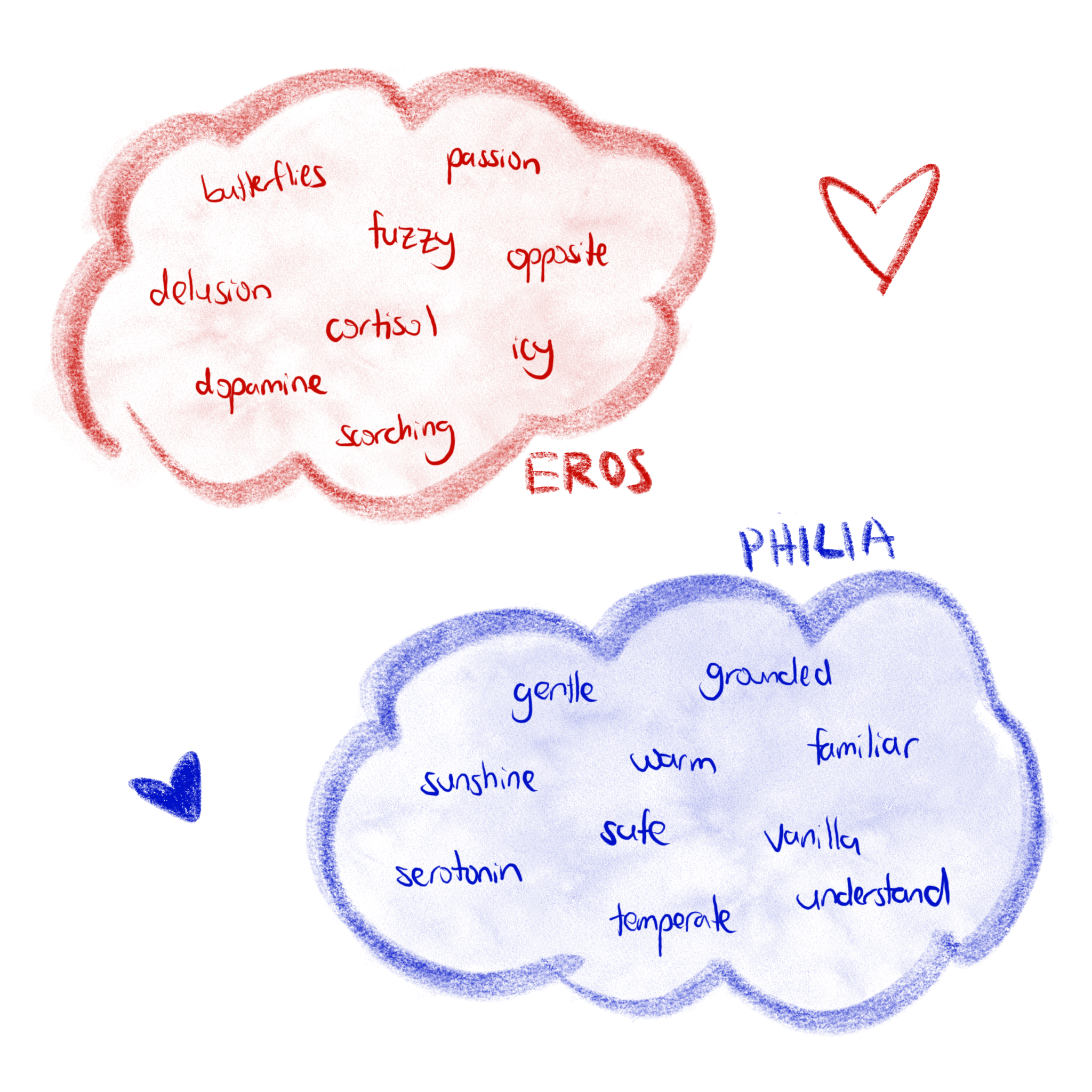
society as a whole seems to have arrived at a similar conclusion, because eros and philia fall roughly along the canonical definitions of romantic and platonic love
nonetheless, i’m not using the words romantic and platonic because of the implications that are baked into their linguistic construction. platonic love, for example, canonically excludes physical attraction, but i personally weight (physical / aesthetic) attractiveness approximately equally in all types of relationships. therefore, counter to conventional notions of romantic and platonic attraction, attractiveness for me would be something like a vector positive in both eros and philia. similarly, sexual attraction is canonically pure eros, but it doesn’t feel to me that sexual attraction is a form of love at all (read: i am probably asexual), so for me it would be something that simply has no projection in this subspace. in this framework, eros and philia are fixed, and the diversity of experiences and perceptions of love by different people are understood by where they lie among these axes. eros and philia are somewhat abstract quantities, defined as the two highest orthogonal principal components of love, and thus varies from person to person
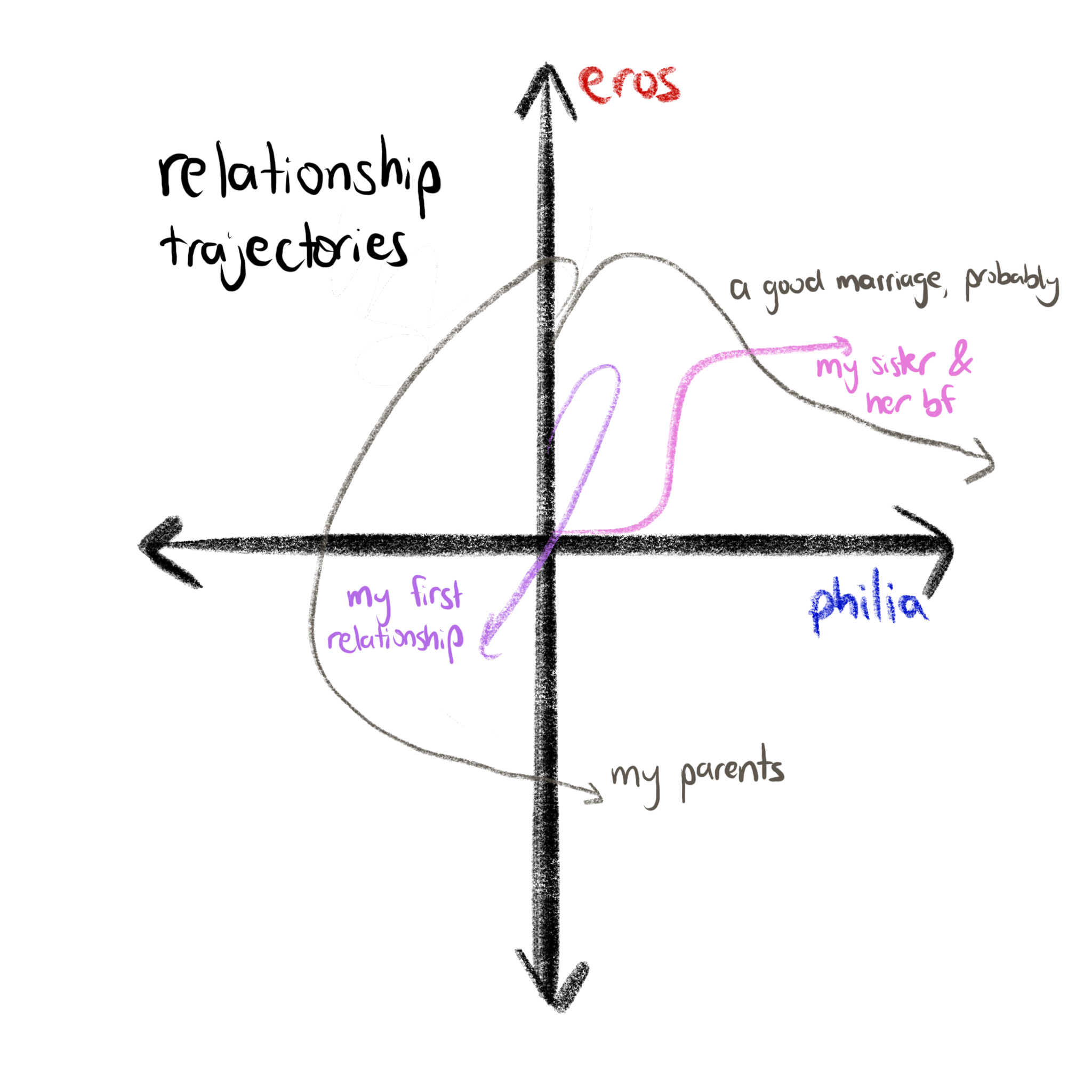
what i dislike the most about the words romantic and platonic love is the implication that platonic love is not romantic. one can have friendships that are eros, and relationships that are philia. i know this because the most romantic relationship of my life has been my friendship with you
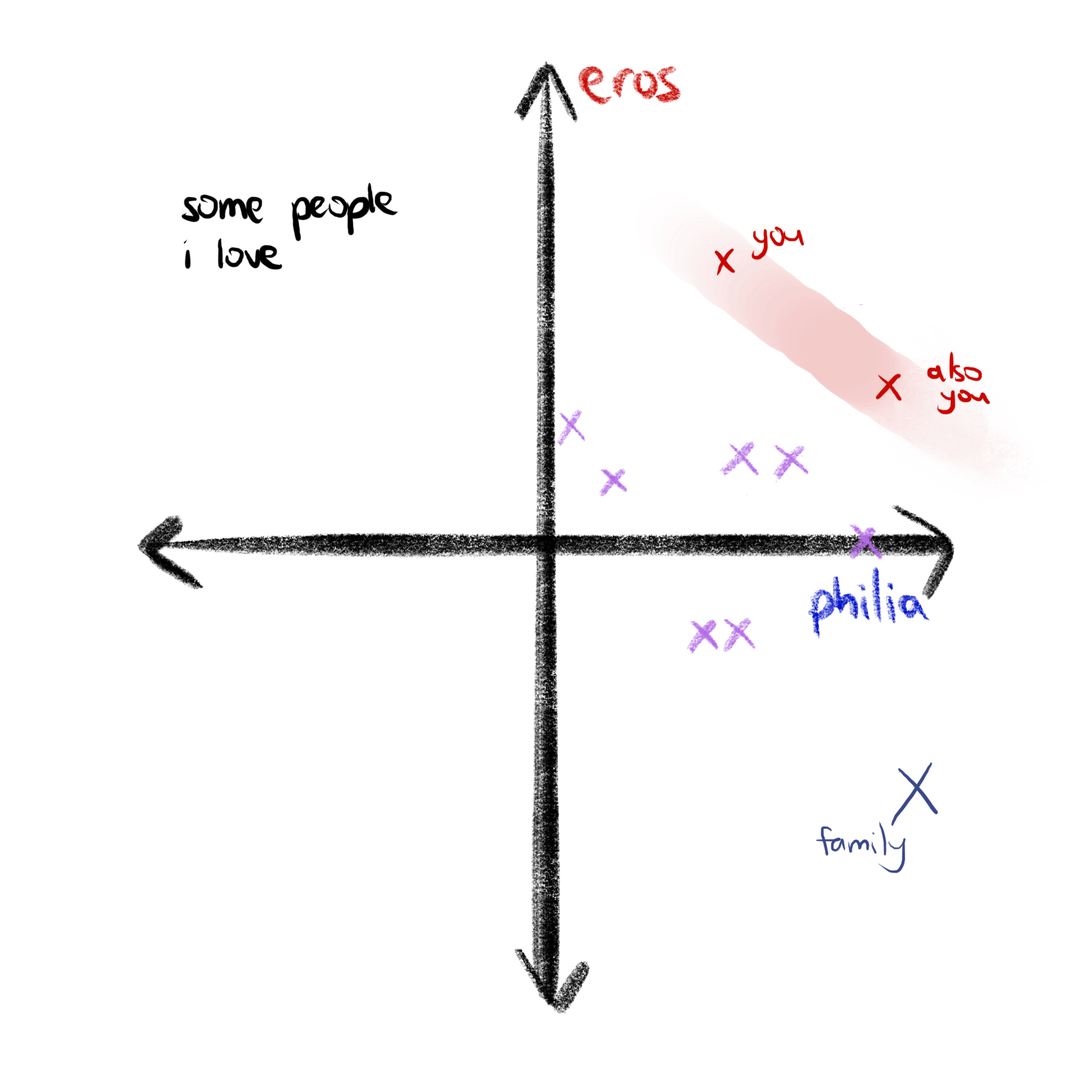
this theory is of course a simplification: love is a subtle and beautiful and complex emotion that has far more degrees of freedom than two. the words eros and philia are only two among numerous greek categories of love; the r/Asexual wiki deconstructs attraction into five different types, including romantic, sexual, sensual, aesthetic, and platonic. but the beauty of finding the principal components is that it helps you understand most of the thing you’re trying to understand with much less complexity, at the cost of some of the finer details
with this compression, we can now define things like orientation. a definition consistent with how most people seem to identify their orientation is one’s feeling of eros as a function of gender. there is already some subtlety here; sexual attraction, for example, is not always aligned with eros, which is the central thesis of the asexual community:
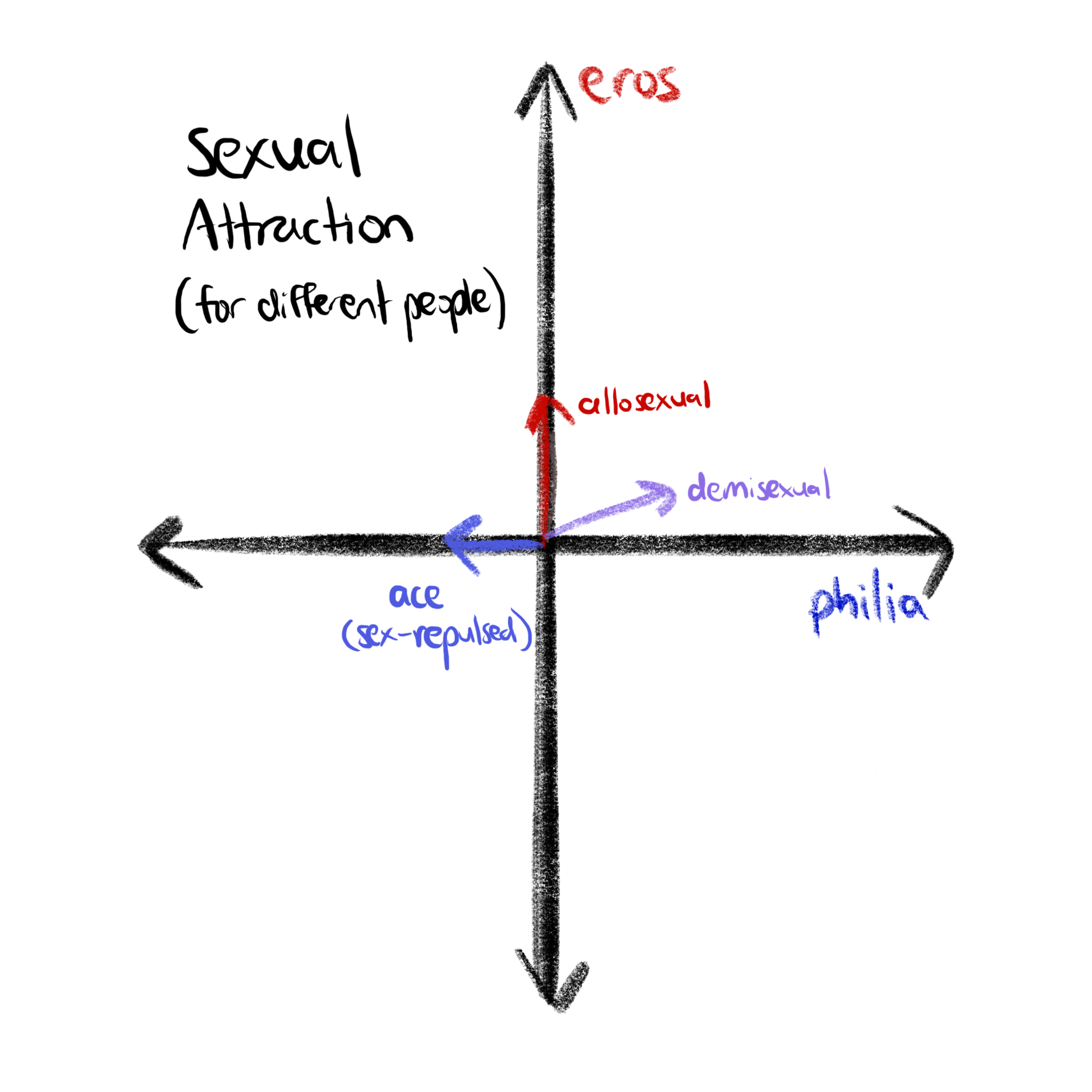
indeed, many ace individuals are able to identify their romantic orientation (eros) with little to no experience of sexual attraction. but here, the implication remains that even if romantic and sexual attraction are not always aligned, eros is what canonically defines romance. this used to be easily internalized. as a teenager, i knew when i liked someone if i daydreamed, if my heart raced, if my stomach dropped and the blood rushed to my face. eros was the only love i could identify because it was something that could take over my life, and in that sense i used to be outrageously straight
with the benefit of hindsight, i know that i was craving the wrong things, back then. after all, eros is an objectively terrible heuristic for determining whether or not your relationship will succeed in the long run. all good long-term relationships i know converge to a state where philia is at least comparable to—and sometimes far exceeds—eros. and yet, eros is the universal heuristic we all use to mark romantic attraction
i’d like to propose the idea that romantic orientation ought not to be defined by eros, but instead by the metric distance of love as a function of gender. for me, and i think for many, this is less a function of gender and more a function of the individual relationship, which implies that nearly everyone ought to be panromantic. this is a world i’d like to live in, but unfortunately do not
i suppose i’m confused because i’ve been feeling a lack of eros lately, especially when i am doing well. by lately, i mean the past two and a half years since the last time i was in a relationship. the exceptions are a brief period in the care of a friend following a severe injury, and the two times in the past two and a half years that you exited and entered a relationship
i write this in the hopes that to deconstruct something is to set it free. i’m trying to understand what it means to love someone, and i’m trying to deconstruct what i meant when i said i love you, even though i no longer know what you meant when you said it back
perhaps the most definitive quality of eros is that it is bittersweet. anne carson argues that the bitterness is not so much a consequence of eros but rather an inherent property, inseparable from its sweetness. eros is desire, and one cannot want something that one does not lack
thus, eros is a hole. it is the tension between the real and the imagined, the i love you i spoke and the i love you i write now. it is an edge that invites me to hope that it does not exist. all other familiar qualities of eros, like butterflies and disappointment, follow from eros as this sparkling boundary of knowledge, juxtaposed with implicit desire
one cannot want something that one does not lack, so maybe eros is an emotion fuelled by incompleteness, and therefore, greed and insecurity. maybe i don’t feel eros very much anymore because i am more complete than when i was a teenager. there is less unknown, because i have experienced good relationships and terrible breakups and brilliant friendships. there is less that i lack, because my current relationships are all sensibly and stably constructed from mutual understanding—philia. i want to believe in a platonic ideal of love, perfectly and kaleidoscopically symmetric—a love that demands nothing, and yet achieves everything. but theorizing about geometric constructions doesn’t help me shake the feeling that in the absence of eros, i’m missing something beautiful. like curiosity, or a daydream
when i really scrutinize my feelings, i think it is empirically true that i still tend to feel eros more towards men than women, which often fades after i get to know them better. this is easily understood if eros is a boundary of knowledge; after all, i will never truly know cisgender masculinity. on the other hand, it was often easy to believe that i didn’t love you romantically because there was often no tension at all between what we said and what we knew. that’s what i loved about us, this connectedness that knew no epistemological limits. in hindsight, that could have been an illusion, woven by both you and i. so when you unexpectedly love someone else, eros reaches down my throat and distends the heart from my lungs
would you call that platonic love, or romantic love?
there are many ways i can say what i mean, like when i tell you that i love you. only the ambiguity of that statement holds enough space for us. in seeking more words to hold my feelings i have instead crushed them into this narrow subspace spanned by language. and yet i have no other choice
for a long time, the closest syntactic formulation i had for how i felt was romantic love. but i undestand now that it was something else entirely. i didn’t like you in the way that i liked men, which often felt empty and electric like vacuum tubes. in the space of eros and philia and all the emotions i’ve ever experienced, you alone occupy the singularity that you do
when i said i love you, what i really meant was this—i think you’re my favorite person. i love how you smile, and i love how you love. i love who we are when we’re together. i love that chiaroscuro of us—the way your side profile pierces the backdrop when you’re deep in thought, and your radiance my soul. you’re the only person i will shamelessly triple text, because everything from trader joe’s piquant popcorn to my sunset lamp reminds me of you. because somehow, it feels wrong to experience joy without sharing it with you. when i stretch my arms in the california sunlight i want to call out to you to bask in it too. your afterimage is seared into my retinas. limerence, blue and glimmering like sparkles on the sea
and so against your wishes i fly too close to the sun. i reach desperately towards a future where i wake up and make two cups of coffee, one for me and one for you. this new england winter was the coldest i had ever felt and you’ve escaped it. you ask me if we’ll be together in every universe. is it tragic that in every possible future i end a witness to your story? it’s always you, adorned in a snow-white dress and a faceless man, and i’m crying tears of an emotion i have yet to know
but i hope i—we—are happy. we must be, because i love you, and because you love me
our eros was a boundary of knowledge, blue and glimmering like sparkles on the sea. to understand is to blur this horizon, soften the fall. so it’s alright, now. i think i’ve written enough to touch the water. there is still so, so much love in my life
as my lungs fill with ocean tears, i close my eyes and breathe
inspirations: eros the bittersweet (anne carson), elseship (tree abraham), kaleidoscope (chappell roan), blue (billie eilish), the summer hikaru died
happy valentine’s day <3
sorry to anyone who is actually familiar with greek, because i don’t really know if this is the right usage of these words. but i had to pick two words that were somewhat appropriate from an unfamiliar language in order for this to work for me
enjoyed this
this is so eloquently written! wish i could ask everyone around me that i love how they would map their own projections onto this theory